The roll that lives under the meat counter
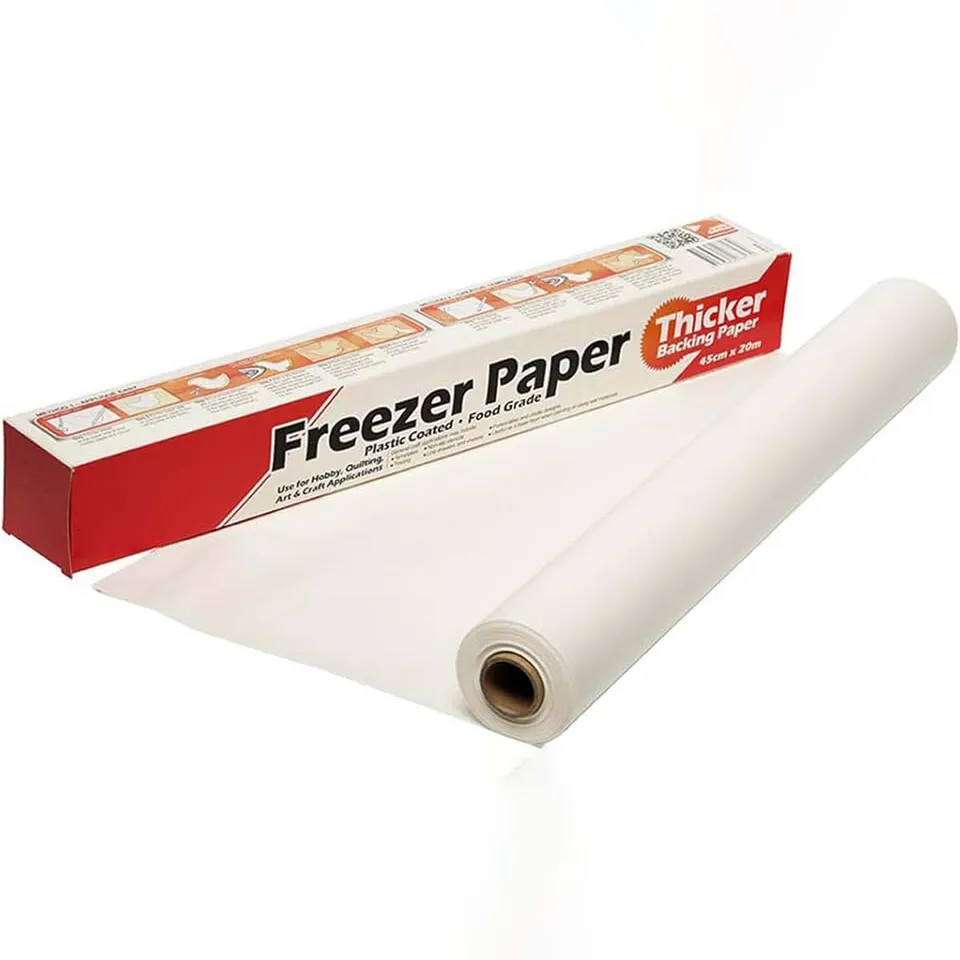
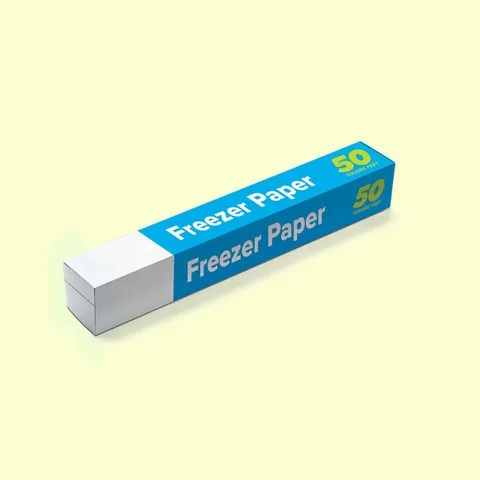
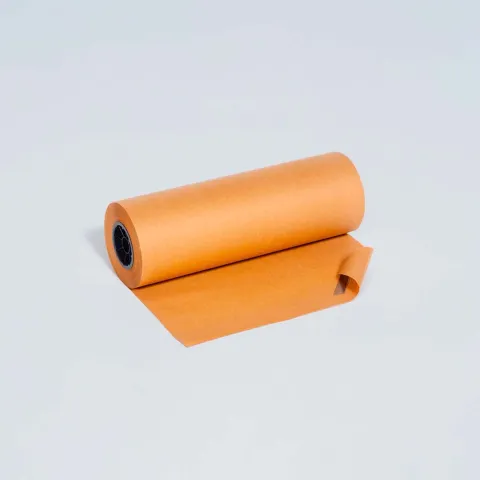
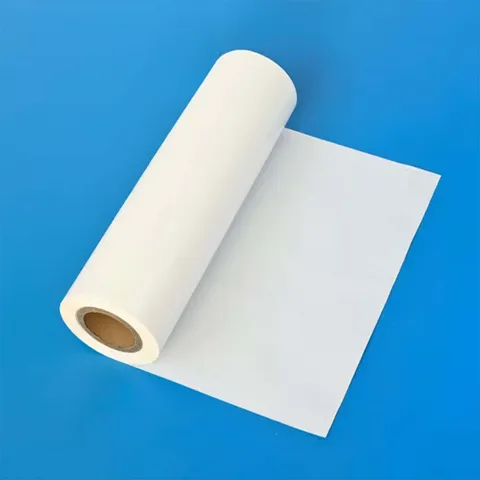
The first two photos show the short format: a white roll inside a long printed carton with a tear edge along the lid. The third shows the paper pulled out across a wooden bench, with the brown core showing at the end of the roll.
That is the version a high-street butcher keeps by the till. A boning room, or a farm shop with its own cutting bench, uses the long bench rolls instead. Those come bare on a core and sit in a dispenser with its own blade.
Fishmongers and game dealers use the same paper. Fillets, a whole trout, a brace of pheasant or a haunch of venison all go in it the same way as a beef joint.
Which side of butcher's freezer paper touches the meat?
The coated side. Hold a piece up to the window and one face has a faint sheen. That sheen is the polythene film, and it goes against the meat.
The other face is bare paper. It stays dry on the outside of the parcel and takes a marker pen or a counter label without smudging.
Get it the wrong way round and the paper face wicks blood and juice while the film faces the freezer, doing nothing. Staff new to the counter get told this on their first morning.
How long will a joint keep in butcher's freezer paper?
Wrapped tight, with the air pressed out, a joint or a 500 g pack of mince keeps well for months at −18°C. The film stops moisture leaving the meat, so the surface does not dry out and turn grey.
Frost forms wherever there is air. A loose parcel traps pockets of it, and that is where the burn starts, so the fold matters more than the paper.
For long storage some butchers put a layer of cling film under the paper. The paper still does the main job: it blocks air, it stops the parcels sticking together, and it carries the label.
Which roll width suits a counter, a cutting room or a farm shop?
Width should clear the widest cut you wrap, with enough left to fold over twice. For chops, steaks and mince in small packs, 380 mm is plenty. A whole brisket, a rolled rib or a leg of lamb wants 450 mm or more.
| Typical roll | Format | Where it suits |
|---|
| 380 mm × 25 m | Boxed, tear edge | Till and counter, small packs, home-freezing orders |
|---|
| 450 mm × 50 m | Boxed or bare on a core | Busy counter, joints and whole chickens |
|---|
| 450 mm × 300 m | Bare on a core for a dispenser | Cutting room, farm shop packing bench |
|---|
| 600 mm × 300 m | Bare on a core for a dispenser | Large joints, whole fish, game in the fur or feather |
|---|
Those four are the usual picks. Any other width or length is a custom slit, and the roll width and length chart shows how to measure for it.
Weight and the coating
The base sheet is a bleached white paper of about 45–60 gsm, with the polythene film on top of that. It feels thicker than greaseproof and does not tear on a bone end the way a thin wrap does.
Pick the lighter end for retail packs that the customer unwraps the same week. Pick the heavier end for long freezer storage and anything with sharp edges, such as a rack of ribs or a dressed crab.
The film is thin enough to crease cleanly and thick enough to hold moisture in. It is not greaseproof in the oven sense, and it is not meant for heat of any kind.
How to wrap a joint so the parcel seals
The butcher's fold is quick once your hands know it. Done properly the parcel needs no tape, though a strip of freezer tape on the last flap does no harm.
- Tear a length about three times the width of the joint and lay it coated side up.
- Set the meat just off centre, nearer to you, and bring the near edge up and over the top.
- Fold the two long edges together and crease them down twice, pressing the air out as you go.
- Fold the open ends into points and tuck them under, tight against the meat.
- Turn the parcel over, write the cut, the weight and the date on the paper side, and freeze.
Air is the enemy. Every fold should press against the meat, and you should feel the shape of the joint through the paper when you are done.
Freezer paper or greaseproof for the chilled counter?
Greaseproof is for the counter and the carrier bag. It wraps a few chops for the walk home and sits in the fridge for a day or two. It is thin and it does not block air for long.
Freezer paper is for anything going below zero. Customers who buy a half lamb or a quarter of beef want every cut in freezer paper, labelled, so the box goes straight into the chest freezer at home.
Plenty of shops run both: greaseproof for the day trade, freezer paper for bulk boxes and home-freezing orders.
Can one roll of freezer paper be the whole order?
Yes. The minimum is one roll, and rolls are priced by the roll on the quote. Tell us the width, the length and whether you want it boxed or bare on a core, and the quote comes back within one working day.
Plain white rolls skip the proof stage, since there is nothing to print. Delivery is free and tracked to any UK mainland address, and the delivery page lists the timings from dispatch.
Payment is by invoice once you have accepted the quote. Bench rolls and counter boxes can go on the same invoice if you want both.
Mistakes to avoid with freezer paper
- Wrapping paper side in, so the film faces out and the paper soaks through.
- Leaving air in the parcel; loose wraps burn at the corners first.
- Using it under a heat lamp or in an oven, where the film softens.
- Tearing short lengths that will not fold over twice on a big joint.
- Writing with a water-based pen that smears when the parcel sweats on thawing.
- Storing the roll somewhere damp, which curls the paper face and makes it hard to write on.
None of these is a fault with the paper, but all of them get blamed on it. A quick word with counter staff saves a lot of wasted roll.
Printing on the paper face
Plain white is the standard. If you want the shop name on every parcel, a one-colour mark on the paper face is possible on the same roll stock, and a printed roll looks tidy in a chilled cabinet.
Printing never reaches the coated side. Nothing sits between the film and the meat. For a repeat pattern, a stripe down the edge or write-on boxes for cut and date, look at printed freezer paper with your logo.