Flat translucent bags for a bakery counter
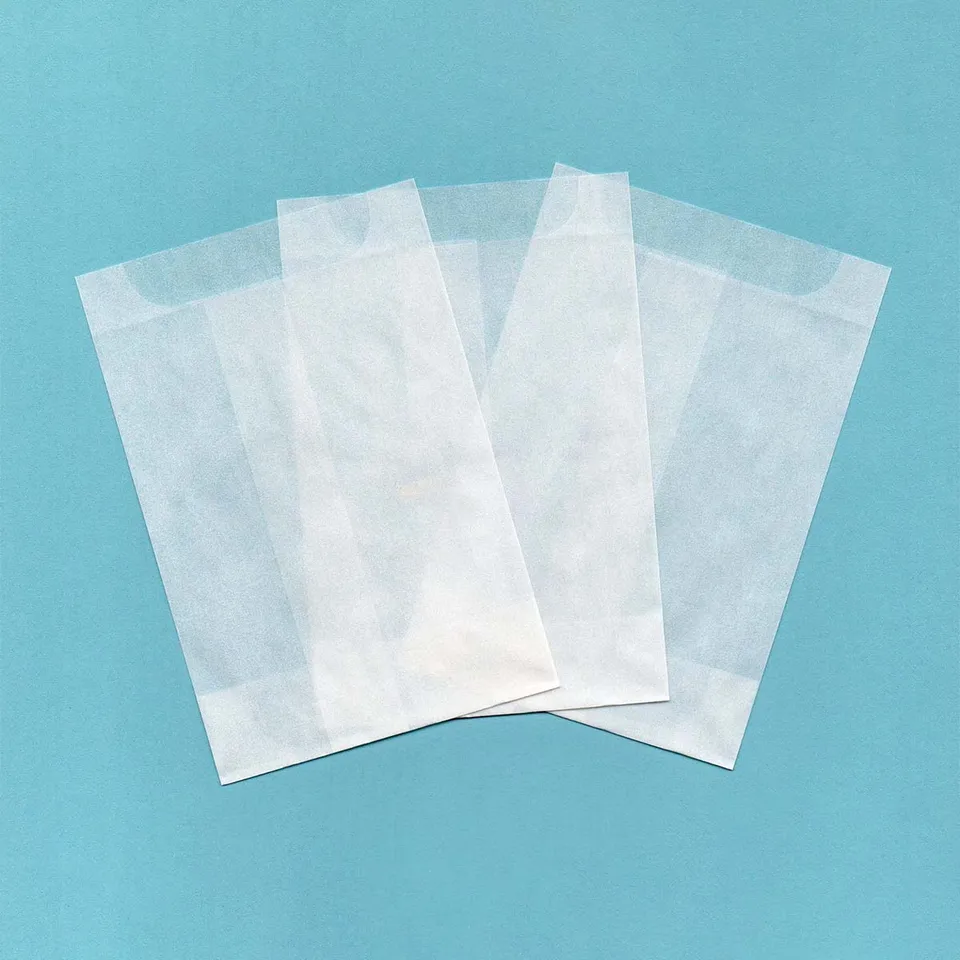
The first photo shows four plain bags fanned out on a pale blue card. You can see the back seam running up through the front of each one, which tells you how thin and clear the sheet is.
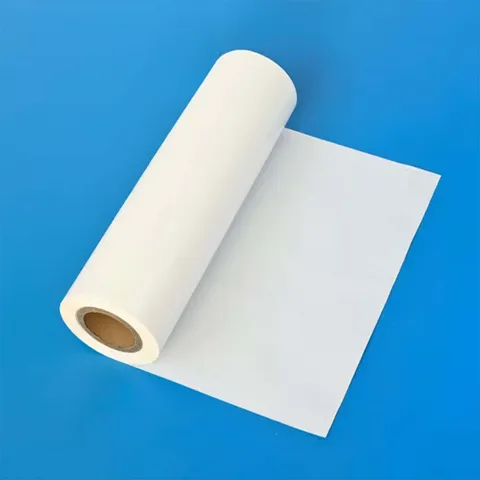
The second photo is the biggest style, a tall bag with a fold-over flap and a folded garment inside. The pattern on the fabric reads straight through the paper, and that is exactly what a customer sees when a slab of tablet or a stack of biscotti sits inside.
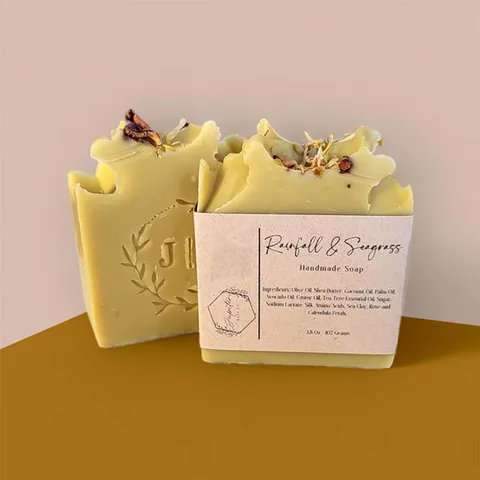
The third photo shows a bag with a pleat folded into the base. Open it and it stands on the bench for filling, then the pleat flattens again when the bag is folded shut.
Why do glassine bags resist butter without a coating?
Glassine starts as an ordinary pulp that is beaten for far longer than usual, then run through heated polished rollers. The sheet comes out so tightly packed that butter and oil cannot find a path through it.
There is no wax layer and nothing to peel, so a glassine bag has no smell and leaves nothing on a pale macaron shell. It also takes a crease and keeps it, which is why the top folds flat and stays put under a sticker.
The weak point is water. A warm sausage roll or a cookie still soft from the oven will steam inside the bag, and the paper goes limp within minutes. Cool everything on a wire rack first, then bag it.
Which glassine bag size fits a macaron, a brownie or a flapjack?
Lay the item flat, measure it, and add about 15 mm to the width and 40 mm to the height for the fold at the top. These four sizes cover most counters.
| Typical size | What it holds | How it closes |
|---|
| 90 × 140 mm | Two macarons, a single truffle, a tea-bag sample, a guest bar of soap | One fold and a sticker |
|---|
| 120 × 170 mm | A brownie, a flapjack, three Welsh cakes, a 100 g bag of fudge | Two folds and a sticker |
|---|
| 140 × 190 mm | A large cookie, a scone, a slice of traybake, a full-size soap bar | Fold-over flap |
|---|
| 190 × 250 mm | A croissant, a slab of tablet, a greeting card, a small bag of coffee beans | Fold-over flap or bottom pleat |
|---|
Those are guides, not rules. If your cookie is 120 mm across, the 120 mm bag will not take it once the seam allowance is counted, so step up a size or ask for a custom width. The sheet and roll size chart explains how we measure a bag flat.
Flat bag, bottom pleat or fold-over flap
All three styles are cut from the same glassine. The choice is about how your staff fill and close the bag, not about the paper.
- Flat open-top: the simplest to make, filled from the side and closed with a fold and a sticker; the usual pick for a single pastry or a portion of sweets
- Fold-over flap: an extra 30 to 50 mm of paper above the mouth that folds down the front, so the bag closes loosely with no sticker and gives you a second printed surface
- Bottom pleat: a fold pressed into the base so the bag opens into a short box shape and stands up for a scoop of honeycomb or a handful of coffee beans
- Back seam on every style: the seam sits up the centre of the back panel, so your artwork goes on the clean front face
Glassine will not heat seal, because there is no plastic layer in it to melt. Close the bags with a fold, a sticker, a paper clip or a length of twine through a punched hole. Rolls of the same sheet are compared with bags on the glassine paper range page.
Will my logo read on a see-through bag?
Yes, provided you plan for what sits behind it. The bag is translucent, so a dark brownie behind a black logo swallows the mark, while a pale shortbread behind it looks sharp.
Deep inks suit glassine best: black, bottle green, navy, a dark red. We match Pantone solid-coated references, and the result on white glassine sits very close to the swatch. A white ink is possible too, and it prints as a frosted mark that shows up well over coffee beans or dark chocolate.
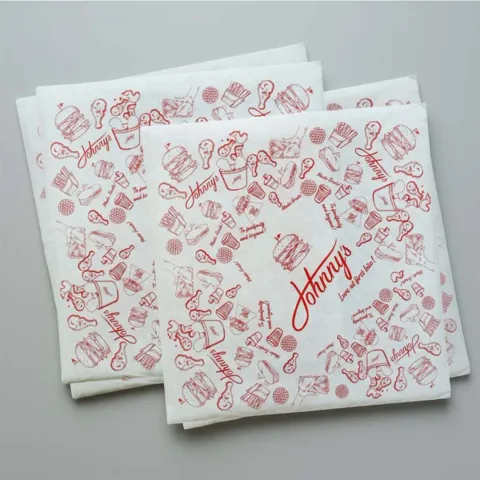
Keep the artwork small. One logo centred on the front panel, or a light scatter of small marks, lets the paper stay clear. Cover the whole front with ink and you have paid for a window and then painted over it. Our guide to printing on greaseproof paper shows how a proof mocks up the transparency.
Weight and tint: 30 or 40 gsm, white or cream
Glassine for bags runs from about 30 to 40 gsm. The lighter end crackles in the hand and folds like tissue, and it is what most patisseries choose. The 40 gsm end is stiffer, stands up better with a pleated base and feels more like a gift bag.
Both weights have a faint sheen from the rollers and feel slightly cool to the touch. That is the cue that tells a customer the bag is glassine and not a coated paper.
White shows ink colour most truly. A pale cream tint is also available; it warms a one-colour brown or dark green print and suits a farm shop or a deli counter.
Glassine bags beyond the bakery: soap, seeds and stationery
Not every bag we print holds food. Cold-process soap makers take the 140 × 190 mm size for a single bar, because the glassine stops the surface oils of a fresh bar from marking the outside and still shows the colour of the soap through the front.
Seed sellers, loose-leaf tea blenders and letterpress stationers use the smaller sizes for packets and cards. The tall flap bag in the second photo is doing that job: a folded item inside, the print visible through the paper, the flap turned down to close it.
If soap is the main use, start with our guide to wrapping bar soap. A bar that has not finished curing will sweat into any paper, glassine included.
What goes wrong with glassine bags?
Three things, and all three are easy to avoid.
Bagging warm bakes. A cookie straight off the tray steams, the glassine softens and by the time it reaches the customer the crackle has gone. Twenty minutes on a rack solves it.
Choosing by width alone. A 120 mm bag does take a 100 mm cookie, but once the top is folded twice there is almost no clear paper left and the logo disappears into the fold. Allow for the closure when you measure.
Ordering a heavy design. Four solid colours on glassine look like a carton and hide the product. One mark, one or two colours, and leave the rest of the bag as the window it is meant to be.
How to order custom printed glassine bags
- Pick a size from the table, or give us the flat width and height in millimetres with the flap or pleat depth if you want one.
- Choose white or cream glassine and tell us how many ink colours the artwork needs; most bag jobs are one or two.
- Send vector artwork if you have it, or a clear photo of your current sticker and we redraw it for the proof.
- A written quote comes back within one working day with the bag, the print and the quantity set out.
- Approve the quote and a free design proof follows; change it as many times as you need before anything prints.
- Production takes 4 to 6 working days after proof approval, then free tracked delivery to UK mainland addresses in 2 to 3 working days.
The minimum run is 1,000 bags in one size and one design. A misprint or a crushed carton, reported with photos within 10 days, is reprinted or refunded. Start on the quote form for printed bags with the size, the quantity and your file; nothing else is needed to get a price.