Why does a cold-process bar need a grease barrier?
Cold-process soap is made from oils and butters, and most recipes are superfatted: a little of the oil is left unreacted on purpose so the bar is gentle. That free oil migrates slowly to the surface, faster in a warm room or a sunny shop window.
On ordinary paper or card the oil wicks straight in. Within three or four weeks a halo spreads out from the bar, the paper goes translucent and any print on top looks greasy. Olive, castor, avocado and shea are the usual culprits, and they are in almost every artisan recipe.
Greaseproof holds that oil at the inside face. The outside stays matte and dry, the ink stays crisp, and a bar that has sat in a basket at a craft fair all weekend still looks freshly wrapped.
Cure first: when is a bar ready to wrap?
Wrapping too early is the most common cause of a stained band, and no paper fixes it. A cold-process bar needs its full cure, usually four to six weeks, so that water can leave and the bar hardens. Wrap it damp and the moisture, not the oil, is what marks the paper.
Two checks before you reach for the paper. The bar should feel dry and room-temperature on every face, including the cut sides. And it should have stopped losing weight; weigh a bar from the batch each week and wrap when the figure holds for seven days.
Melt-and-pour bars are different. They sweat glycerine in humid air rather than oil, so they want a glassine bag or film first and a band over the top. Hot-process bars can be wrapped sooner, but give them at least a fortnight.
Band, full wrap or box: which suits your bars?
There are three ways to dress a bar in paper. The right one depends on how the bar is sold, how much of it you want on show and how much labelling it must carry.
| Format | What it covers | Good for | Watch out for |
|---|
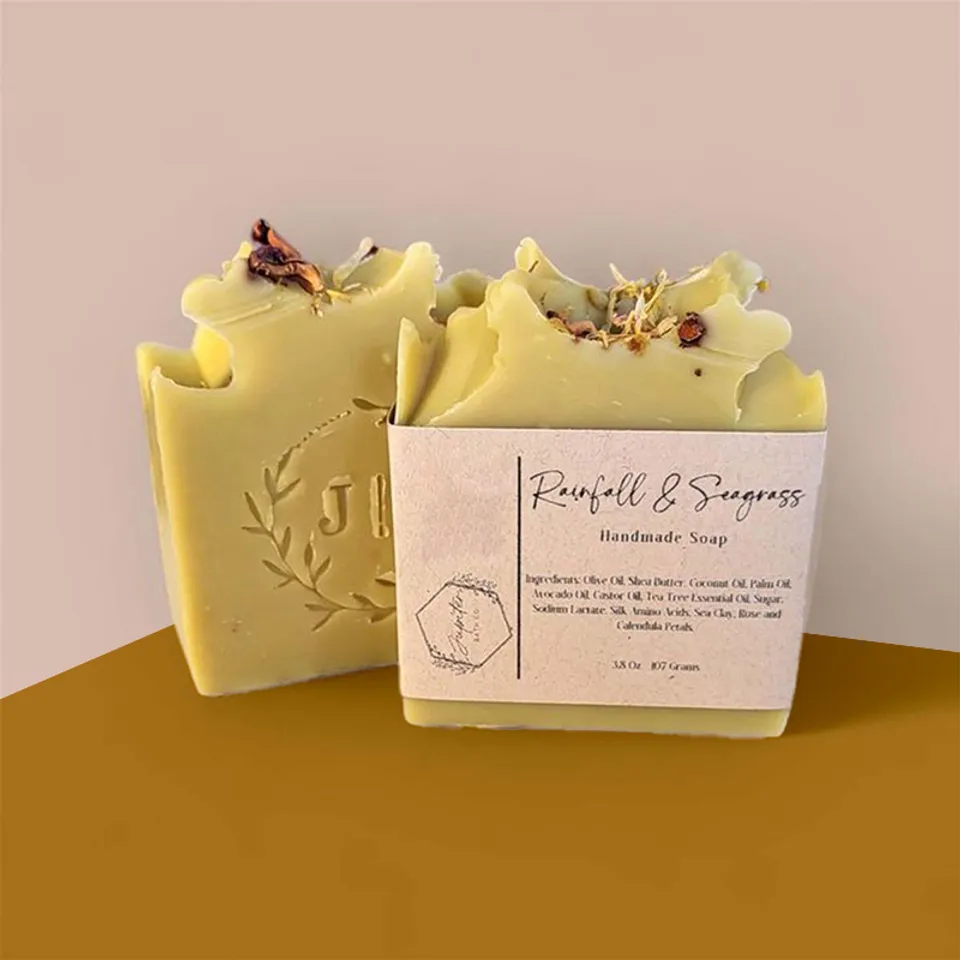
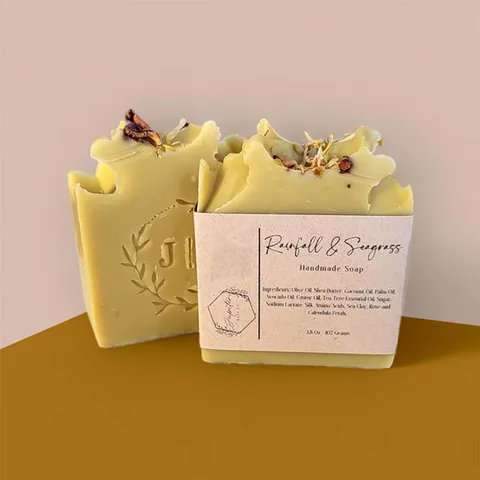
| Printed band | A strip around the middle, bar on show top and bottom | Market stalls, rustic bars with botanicals on top | Exposed faces pick up dust; bar must be fully cured |
|---|
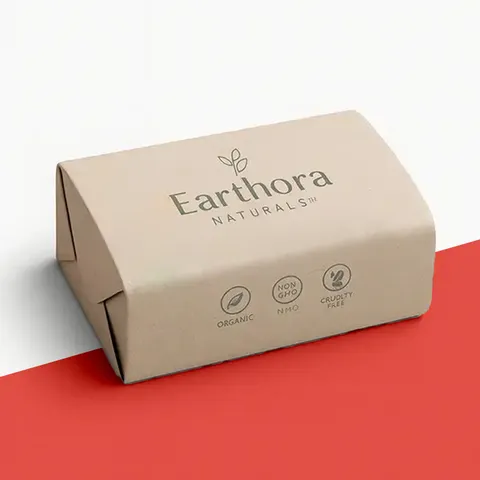
| Full greaseproof wrap | The whole bar, folded like a parcel | Shops, gift sets, bars that travel in the post | Takes longer to fold; needs a label or band to close it |
|---|
| Wrap plus band | Full wrap with a band over it | Retail shelves, wholesale to shops | Two items to order; keep the artwork consistent |
|---|
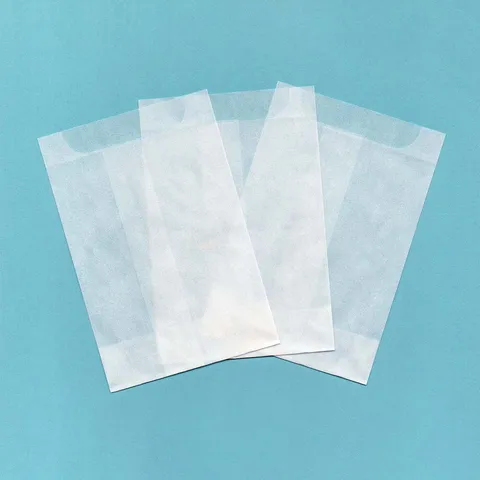
| Glassine bag with band | Bar inside a translucent bag, band outside | Melt-and-pour, loaf-cut slices, favours | Bag must be big enough to fold shut |
|---|
Most makers start with a band because it is quick and shows the bar off. Once bars go into shops, a full wrap keeps them clean on a shelf that gets handled all day. The soap wrapping paper range covers both.
How to fold a full wrap
A neat parcel fold takes about twenty seconds once your hands know it. Work on a dry surface with the printed side facing down.
- Place the bar face down in the centre of the sheet, with the long edge of the bar parallel to one edge of the paper.
- Bring the two long sides of the paper up and over so they overlap by about 15 mm along the back of the bar, and crease the overlap with a thumbnail.
- At one end, push the two side flaps in flat against the bar, so the top and bottom form two triangles.
- Fold the top triangle down, then the bottom triangle up, and press the point flat against the back.
- Repeat at the other end, pulling the paper taut before the last fold so the front face is smooth.
- Turn the bar over, check the logo sits where you want it, and seal the back with a small label or slide a band over the whole parcel.
If the paper slips as you fold, it is cut too large. If the triangles will not close, it is too small. The sizing section below gets it right first time.
Sizing the sheet and the band to the bar
Most handmade bars fall between 80 and 100 mm long, 50 and 70 mm wide and 20 and 30 mm thick. The sizes below suit those; anything outside is a custom cut.
- Full wrap for a standard 90 × 60 × 25 mm bar: 200 × 200 mm, which gives a comfortable overlap on the back and tidy end triangles.
- Full wrap for a small guest bar of about 60 × 40 mm: 150 × 150 mm.
- Full wrap for a large or loaf-cut bar up to 110 × 75 mm: 250 × 250 mm, and 300 × 300 mm if the bar is thick or has a domed top.
- Band for a 60 mm wide bar: 50 × 230 mm, going around the bar once with a 20 mm overlap to glue or tape at the back.
- Band for a chunky 75 mm bar: 65 × 250 mm or 75 × 280 mm, which also gives more room for an ingredients list.
- Glassine bag for a standard bar: 120 × 170 mm, leaving enough at the top to fold over twice.
To check a band length, wrap a strip of ordinary paper around the bar, mark the overlap, and add 20 mm. The four typical cuts on the printed soap band sizes page cover nearly every bar we see.
Printing a band that stays clean
Soap bands are printed on greaseproof with food-safe soy and water-based inks, one to four colours, matched to Pantone solid-coated references. The ink dries into the fibre, so a band can be pulled tight around an edge without cracking.
Kraft greaseproof is the natural partner for a rustic bar with calendula or lavender on top. Print one dark colour on it: black, deep green, aubergine or a warm brown all sit well. White stock suits pastel bars and brands with a brighter palette, and it takes two or three colours without looking busy.
Keep the front of the band for the brand name and the scent, and put the small print on the back. Text smaller than 6 pt will not survive the press.
What goes on a soap wrap or band?
A band does two jobs: it sells the bar at arm's length and tells the buyer what is in it up close. The front wants the maker's name and the scent, and little else. A buyer at a stall decides in two seconds.
The back carries the detail: the full ingredients in descending order, the weight in grams, your business name and a way to contact you, plus any batch reference. If you sell into shops, a barcode goes here too, in black on white.
Put the long text on the band rather than the wrap. A band is easy to reprint when a recipe changes; a full wrap with the ingredients printed across it means a whole new run for one line of text.
Will essential oils stain a printed greaseproof wrap?
Essential oils are a different problem from the base oils. They are volatile, so most of the scent leaves through the paper as vapour rather than wicking in as a stain. A glassine bag slows this more than a wrap, which is why strongly scented bars are often bagged first.
A few dark oils, such as patchouli and vetiver, can tint the inside face of a kraft wrap over months. It never shows on the printed outside, and a white wrap shows it sooner than kraft.
Colourants are the thing to watch. A bar coloured heavily with charcoal or a strong mica can dust the inside of the wrap, so brush the faces a day after planing before you wrap.
Mistakes makers make with paper
The first is tissue paper, which is pretty for a week and then shows every drop of oil. The second is a glossy laminated label stuck on greaseproof: the glue sits on a sheet designed to stop things soaking in, so it lifts at the corners. Close the wrap with a paper label on a permanent adhesive, or a band.
The third is wrapping in a damp kitchen straight after cutting. Greaseproof stops oil, not steam, and a bar that is still losing water will mark the paper from inside. Wrap in a dry room after the cure, and store wrapped bars with a little air between them.
The last is over-ordering sizes. One wrap size and one band size cover most ranges, because bars from one mould are the same shape whatever the scent.
Ordering wraps and bands together
Both come from the same artwork, so order them on one quote and the proofs are matched: same Pantone, same logo scale, same kraft or white stock. The minimum is 1,000 of each, which for a small maker is usually a year of bands and a season of wraps.
Send a vector logo, the bar dimensions and the sheet or band size from above. A free proof follows with unlimited edits, printing takes 4 to 6 working days after approval, and delivery to UK mainland addresses is tracked and free.
If you are unsure of the size, say so on the soap wrap and band quote form and ask for a stock sample with the quote. Folding a plain sample around your own bar answers the question faster than any chart.