Who buys custom printed greaseproof sheets
Sandwich shops are the biggest buyers of these sheets, and it is easy to see why. A cheese and pickle on granary gets folded into a pocket, the logo faces out, and the paper goes in the bag.
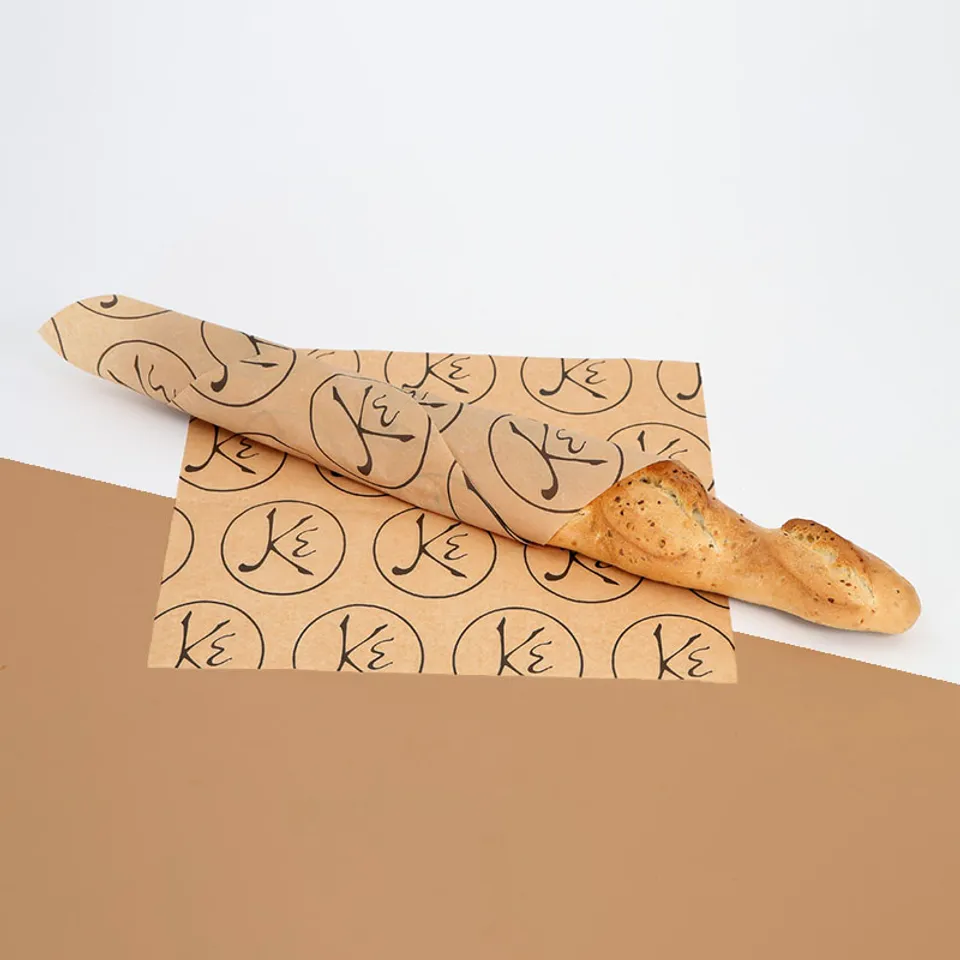
The first photo shows a kraft sheet with a dark one-colour monogram repeated across it. The baguette rolls up inside, the last turn tucks under, and nothing needs taping.
Bakeries use the same sheet under a sausage roll on the counter. Delis lay one on the scales before the ham goes on. Cafés slide a slice of cake onto a sheet before it goes in a box.
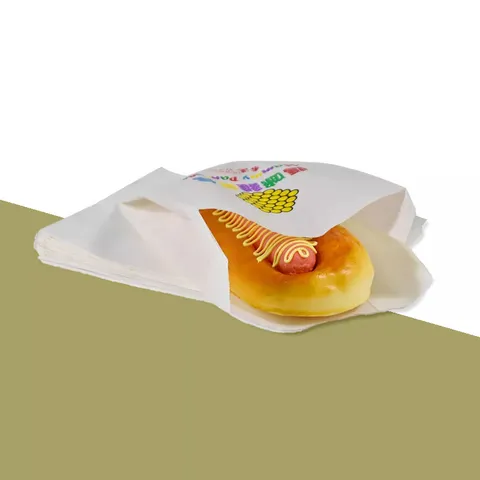
The second photo is the white version, folded into a simple pocket around half a sandwich. That fold is the one most UK counters use all day.
How does greaseproof paper cope with butter, oil and steam?
Greaseproof paper holds grease because the fibre is beaten until it is almost glassy. Fat sits on the surface rather than wicking through, so a buttered bap leaves no shadow on the outside.
Steam behaves differently. A warm panini wrapped tight will give off vapour, and the sheet lets it out slowly. The bread stays firmer than it would sealed in foil.
A crease holds once pressed. That matters on a baguette, where the paper rolls three times and the last turn has to stay put on its own.
Dry heat is fine. Typical grades take about 200°C in an oven, so a sheet under a pasty in a hot cabinet is no problem. Keep it off the griddle edge.
Which sheet size suits a sandwich, a baguette or a tray?
Measure the thing you wrap, then allow enough paper to fold twice. For a sandwich half, that works out at roughly three times the width of the bread.
| Typical size | What it wraps or lines |
|---|
| 250 × 375 mm | Sandwich halves, croissants, scale sheets for cheese and sliced meat |
|---|
| 300 × 300 mm (12 in square) | Full rounds, bagels, wraps folded into a pocket |
|---|
| 350 × 450 mm | Baguettes, filled rolls, lining a slate or board |
|---|
| 450 × 700 mm | Large loaves, cake boxes, platters for buffets |
|---|
Those four are the usual picks from the catalogue. Anything else is a custom cut, and a sheet cut to your tray saves someone trimming with scissors every morning. Check the sheet and roll size chart before you measure.
Greaseproof versus baking parchment
Buyers mix these two up all the time. Baking parchment has a silicone coat, so it releases a sponge from a tin and survives the oven for an hour.
Greaseproof has no coating. It holds fat, folds crisply and prints beautifully, which is why it wins on the counter. It is the wrong choice for lining a cake tin.
If your sheet never sees an oven, greaseproof is the cheaper and better-looking paper. Our guide to greaseproof paper against wax paper covers the third option as well.
Kraft or white, and what weight?
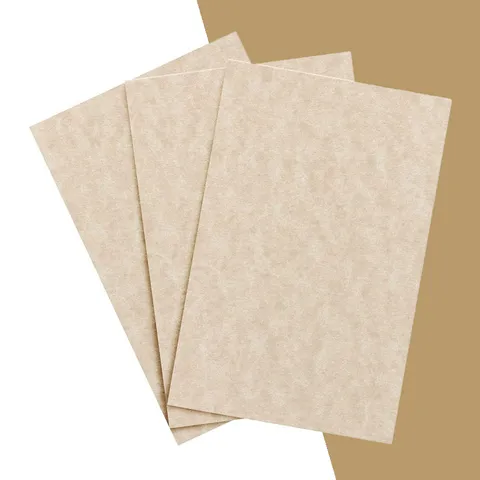
Kraft greaseproof is unbleached and brown. It hides a faint grease mark better than white and suits a bakery or deli that wants a rustic feel. White greaseproof gives a cleaner surface for a second or third colour.
Weight is really about stiffness. A light sheet drapes round a croissant but tears on a busy counter. A heavier sheet stands up as a liner and folds with a sharp edge.
- Light, about 30–35 gsm: pastries, biscuits, scale sheets, anything handled once.
- Standard, about 38–42 gsm: sandwich pockets, baguette wraps, most printed jobs.
- Heavy, about 45–50 gsm: board and tray liners, wraps that spend twenty minutes in a delivery bag.
Torn between two weights? Go heavier for anything that leaves the shop in a bag. The guide to choosing a greaseproof paper weight explains the trade-offs.
How many colours should the print carry?
One colour on kraft is the safest print going. Black, deep brown or a dark red sits on the brown fibre and reads from the other side of the shop. The sample in the first photo is exactly that: one ink, one mark, repeated.
Two colours on kraft look muddy unless one is very dark. Save pastels and pale tints for white stock, where they print clean.
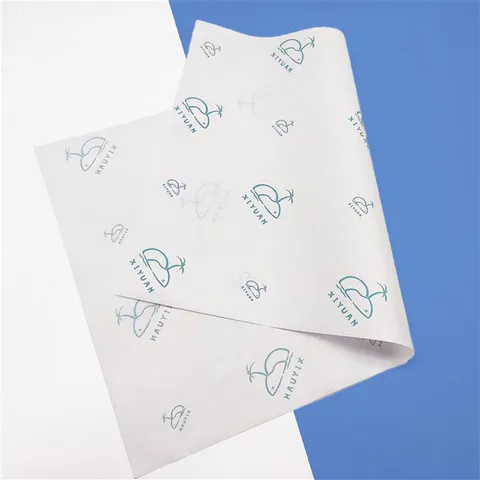
Three and four colour work prints well on white greaseproof, and we match solids to Pantone solid-coated swatches. Expect a small shift on kraft, because the brown base tints every ink laid over it.
Every ink is soy or water-based and dries matte. It will not rub off onto a warm roll. There is more detail in the guide to printing on greaseproof paper.
One logo or a repeat pattern
A repeat tiles your logo across the whole sheet at a fixed spacing. However the sheet gets folded, some part of the mark shows. That is why repeats are the usual choice for wraps that get rolled or bunched.
A single logo suits a sheet that lies flat: a scale sheet, a board liner, a cake base. Place it off-centre and it stays visible once the food is on.
Send artwork as a vector file with text converted to outlines. Keep lines above 0.5 mm, drop any gradient, and leave 10 mm clear at every edge where the cut can wander. You can sketch a layout in Design Your Greaseproof Paper and attach it to the quote.
Packing and keeping sheets tidy on the counter
Sheets arrive flat in wrapped stacks of 500, two to a carton. Keep a stack beside the prep board, interleaved with nothing, and pull from the top.
A tabletop dispenser box with a slot in the lid stops staff fanning the whole stack with wet hands. Most 300 × 300 mm sheets fit a standard deli dispenser without trimming.
Store the cartons somewhere dry. Greaseproof picks up moisture from the air and goes limp if it sits in a damp back room for a month.
What goes wrong with printed sandwich sheets?
The common mistake is ordering too small. A 250 mm sheet looks fine round a thin sandwich and leaves a doorstep wedge half exposed. Wrap one in plain paper first and measure what you used.
The next is a pale logo on kraft. A soft sage green that looks lovely on screen vanishes into brown paper. Pick a darker tint or move to white stock.
Thin text is the third. Anything under about 6 point fills in on uncoated paper. Thicken it or drop the strapline.
Last, people forget the fold. If your logo sits dead centre and the sheet folds in quarters, the mark lands on the crease. A repeat solves this without any thought.
How to order custom printed greaseproof sheets
- Tell us the sheet size in mm, the stock (kraft or white), the weight and how many colours. If you are unsure, say what you wrap and we will suggest a size.
- Attach your logo. We send a written quote within one working day. From £0.25 a sheet is the starting point, and the exact figure depends on size and colour count.
- Approve the quote and we set a proof showing the print laid out at full size. Edits are free until you are happy.
- Production takes 4–6 working days once the proof is signed off, then tracked delivery to a UK mainland address in 2–3 working days.
- The minimum run is 1,000 sheets. Reorders use the same plates, so repeat runs are quicker to set.
Start with a quote for printed greaseproof sheets and mention if you need samples; we add them to the quote.