Which face of printed freezer paper carries the ink?
The bare paper face, which is the outside of the parcel. The coated inner face is never printed.
Printed freezer paper is the coated white roll a butcher wraps with all day, with the shop name printed on the dry paper face. The parcel goes home, into the customer's freezer, and carries your name for as long as the meat is in there.
From £0.25 a sheet; rolls are priced by the roll on the quote. Written quote in one working day and a free design proof; the exact number depends on size, ink count and quantity.
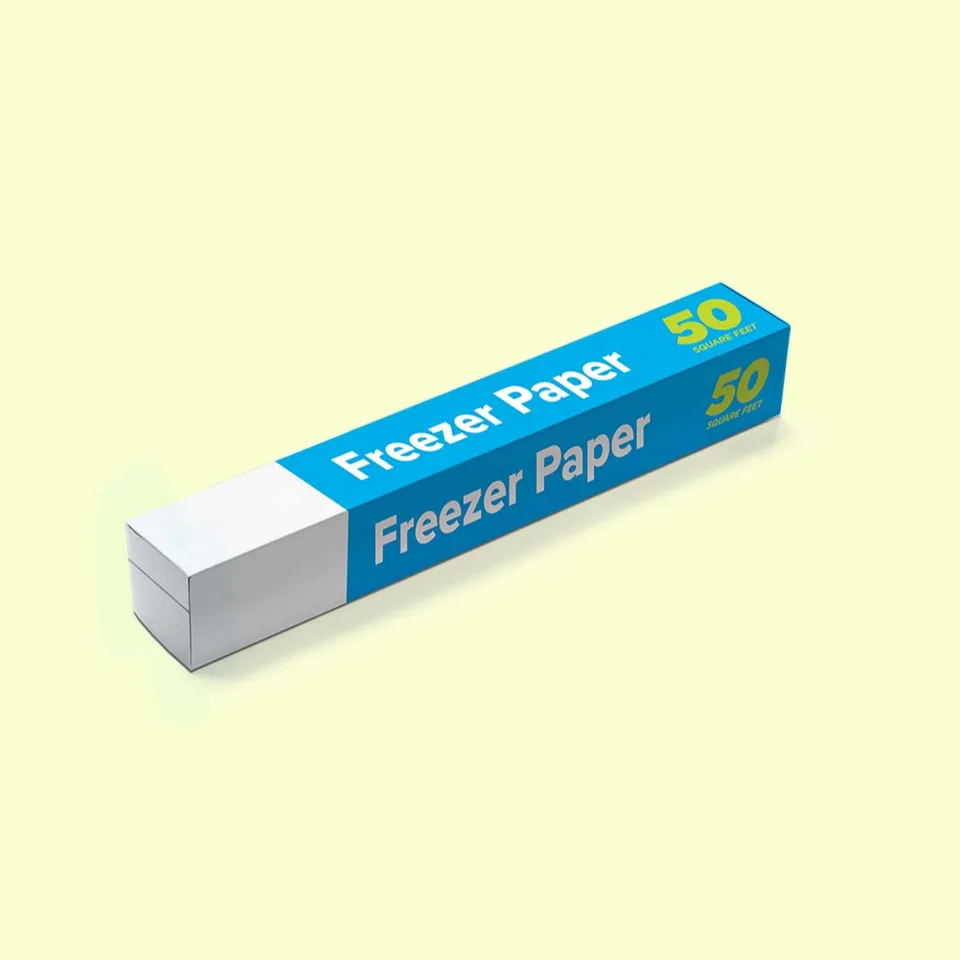
From £0.25 a sheet; rolls priced by the roll. Exact price on the written quote.
| Format | Boxed roll with a tear edge (380 mm × 50 m, 450 mm × 50 m) or bare on a core (450 mm and 600 mm × 300 m) |
|---|---|
| Base sheet | White base paper, about 45–60 gsm, with the film on top |
| Coating | Polythene film on the inner face; print on the bare paper face only |
| Cold | Freezer storage to −18°C (typical); no ovens, lamps or smokers |
| 1–4 food-safe soy and water-based ink colours, repeat pattern or edge stripe, Pantone matches | |
| Write-on | Printed boxes for cut, weight and date on request |
Printed freezer paper is a moisture-proof white paper, coated on one face, with a logo or repeat pattern printed on the uncoated outer face. It wraps meat, fish and game for freezing in the usual way. The print stays on the outside and never meets the food.
| Format | Typical size | Typical use |
|---|---|---|
| Roll | 380 mm × 50 m | Farm shop, small butcher |
| Roll | 450 mm × 50 m | Butcher's counter |
| Roll | 450 mm × 300 m | Cutting room |
| Roll | 600 mm × 300 m | Primal cuts, production |
The four sizes above are the usual picks; any other size is a custom cut, so ask on the quote. Full sheet and roll size chart.
Pick one of this paper's photos, drop your logo on it and send the mock along with your quote request.
Upload a logo and it appears on this sheet
A printed chip wrap lasts ten minutes. A printed freezer parcel sits in a chest freezer for three months with your name facing up every time the lid opens. Few bits of packaging get looked at that often.
The photos show the sample cartons in two colourways, a plain white roll beside its box, and a frozen burger patty half covered by a sheet torn from the roll. The patty shot is the point of the product: film side on the meat, print side out.
The buyers are butchers who sell freezer packs and half animals, farm shops with a meat chiller, fishmongers who freeze a catch for a customer, and game dealers packing a season's birds.
On the bare paper face only, which is the outside of every parcel. The polythene face is left untouched, so there is nothing between the film and the meat.
Because a counter roll is torn to length, the design has to work at any tear point. A repeat pattern or a stripe along one edge covers that. A single logo placed once per metre would often end up inside the fold.
Keep the print to the paper face and the parcel behaves exactly like a plain one. It folds the same, it creases the same, and the marker pen still writes in the clear spaces.
Yes. The inks are food-safe soy and water-based, cured onto the paper before the roll is wound. Cold does not lift them, and the thaw sweat on the outside of a parcel does not run them either.
What does mark a print is abrasion. Parcels dragged in and out of a packed freezer rub against each other. A solid block of colour shows that scuffing more than a line logo does, so keep heavy coverage away from the edges that get handled.
Condensation forms on the outside as the parcel thaws on a worktop. The paper face goes a little limp for an hour and dries flat again; the print stays where it was.
The width rule is the same as for plain paper: clear your widest cut with enough spare to fold the edges over twice. The length decides how the roll lives in the shop.
| Typical roll | Format | Where it works |
|---|---|---|
| 380 mm × 50 m | Boxed, tear edge | Till-side roll for chops, steaks and mince packs |
| 450 mm × 50 m | Boxed, tear edge | Counter roll for joints and whole birds |
| 450 mm × 300 m | Bare on a core for a bench dispenser | Cutting room and farm shop packing bench |
| 600 mm × 300 m | Bare roll on a core, bench dispenser | Half-animal boxes, whole fish, large game |
If you only want a plain roll for now and a printed one later, start with plain butcher's freezer paper rolls and move the same width across when you are ready.
White stock shows colour exactly as the Pantone swatch, so one strong colour is usually enough. A deep red, a bottle green or a navy on white reads from across a shop.
Two colours earn their place when the logo has a second element, say a black outline with a coloured fill. Three and four colours are for a full design and cost more per roll without adding much to a wrap that gets folded.
Our view: a one-colour repeat of the shop name and phone number, printed at about 30 per cent of the sheet area, is the cleanest freezer roll you can buy.
The most useful addition to a freezer print is a small panel of printed boxes: Cut, Weight, Date, and a line for the customer's name. Staff fill it in with a marker and nobody has to find a label.
Panels are printed in a light grey or a pale tint so the pen shows up, and repeated every 250 to 300 mm so one always lands on the outside of the parcel.
A kill date, a use-by prompt or a 'keep frozen' line can go in the same panel. Keep it to a few words so it still fits a chop pack.
A step-and-repeat is the right answer for a counter roll. Logos set in a staggered grid, at an angle, mean every parcel shows at least two whole marks whichever way it is folded.
A single large logo per sheet only makes sense if you cut the roll into fixed sheets for a packing line, where each sheet wraps one tray in the same way every time.
Edge stripes are the budget option. One band of colour along one edge of the roll gives every parcel a coloured seam and uses very little ink.
The printed roll is the same build as the plain one: a bleached white sheet of about 45–60 gsm with a thin polythene film laminated to one face. The print sits on the paper face and is dry before winding.
Printing a full-bleed solid colour. It scuffs in the freezer, hides the marker pen, and makes a thawing parcel look darker and damp. Leave white space.
Setting a tiny web address at 6 pt. Freezer paper has a slight tooth and fine type fills in. Keep text at 10 pt or larger and the logo at least 30 mm wide.
Sending artwork that only works at one orientation. The roll is torn and folded every way, so test the design upside down and sideways before you approve the proof.
The whole thing starts from the printed freezer paper quote form. Attach the logo and mention if you want write-on boxes.
The questions UK buyers ask before a first order. Type a word to filter the cards, or open one for the full answer.
The bare paper face, which is the outside of the parcel. The coated inner face is never printed.
Yes. The food-safe inks are cured before the roll is wound, and freezing or thawing does not lift them.
Yes. The food-safe inks are cured before the roll is wound, and freezing or thawing does not lift them. Only hard rubbing in a packed freezer scuffs a print.
Yes. A small write-on panel in a pale tint can repeat every 250 to 300 mm so one lands on the outside of each parcel.
One to four. Most butchers choose one or two colours on white, which keeps the roll clean and the price down.
No. The print is on the outer paper face only and the polythene film is between it and the food.
Yes, and a staggered step-and-repeat is the usual choice. It means every torn length shows whole logos however the parcel is folded.
The boxed 50 m rolls tear on their own lid, so they need no dispenser.
The boxed 50 m rolls tear on their own lid, so they need no dispenser. The 300 m rolls are bare on a standard core for a bench dispenser.
One roll is the minimum. A longer run on the same plate costs less per roll, so most shops order a few rolls at a time.
Always. A free design proof shows the repeat on the roll, and you can ask for as many edits as you need before anything is printed.
Yes. On white stock a Pantone solid-coated match prints true, so give us the reference and we match it.
No. The film face is untouched by printing, so the parcel seals and keeps frost off exactly as a plain roll does.
About two weeks from quote to door. The quote arrives within one working day, printing takes 4–6 working days after proof approval, and free tracked UK mainland delivery adds 2–3 working days.
No match. Ask us on WhatsApp or call +44 7578 382054.
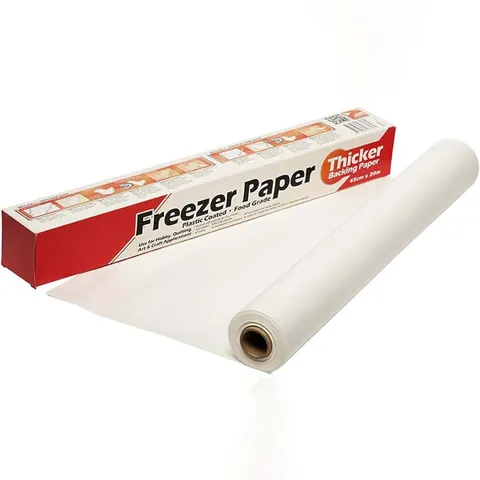 Butcher's Freezer PaperFrom £0.25 a sheet380 mm × 25 m · 450 mm × 50 m · 450 mm × 300 mMeat, fish and game storageSee this paper
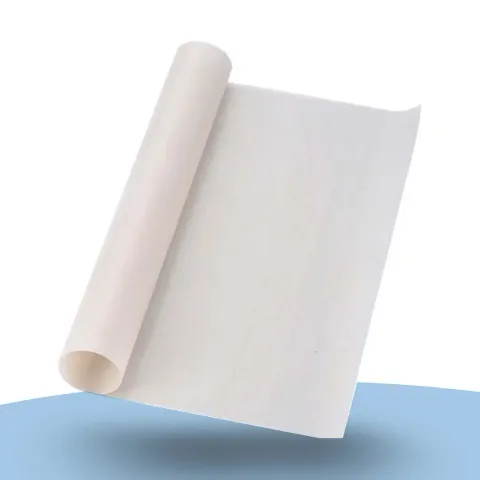 Printed Paraffin PaperFrom £0.25 a sheet200 × 200 mm · 250 × 270 mm · 300 × 300 mmBranded cheese, fudge and sweet wrapsSee this paper
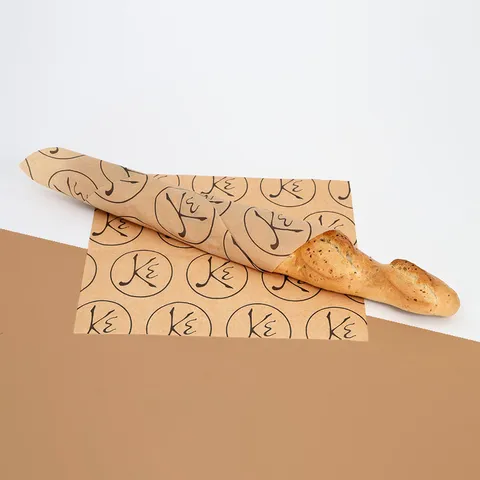 Custom Printed Greaseproof SheetsFrom £0.25 a sheet250 × 375 mm · 300 × 300 mm · 350 × 450 mmLogo wraps for hot foodSee this paper
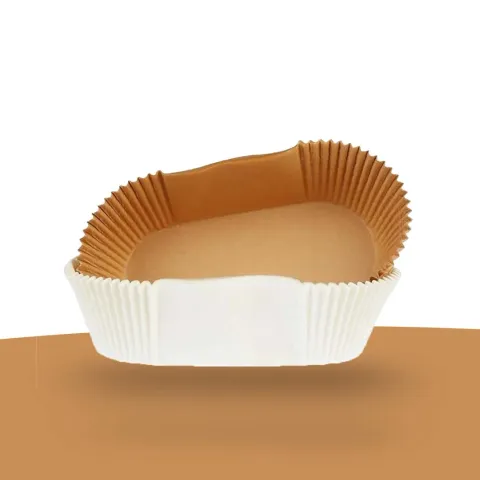 Printed Loaf Tin LinersFrom £0.25 a linerMini (145 × 75 mm) · 1 lb (170 × 95 mm) · 2 lb (230 × 130 mm)Bakery loaves sold in the linerSee this paper
Name the paper, a size and a quantity, and attach a logo if you have one. A written price and a free design proof come back within one working day. Rather talk it through? Call +44 7578 382054 or message us on WhatsApp.